251242 - Couple African Ibeji Yoruba statues - Nigeria.


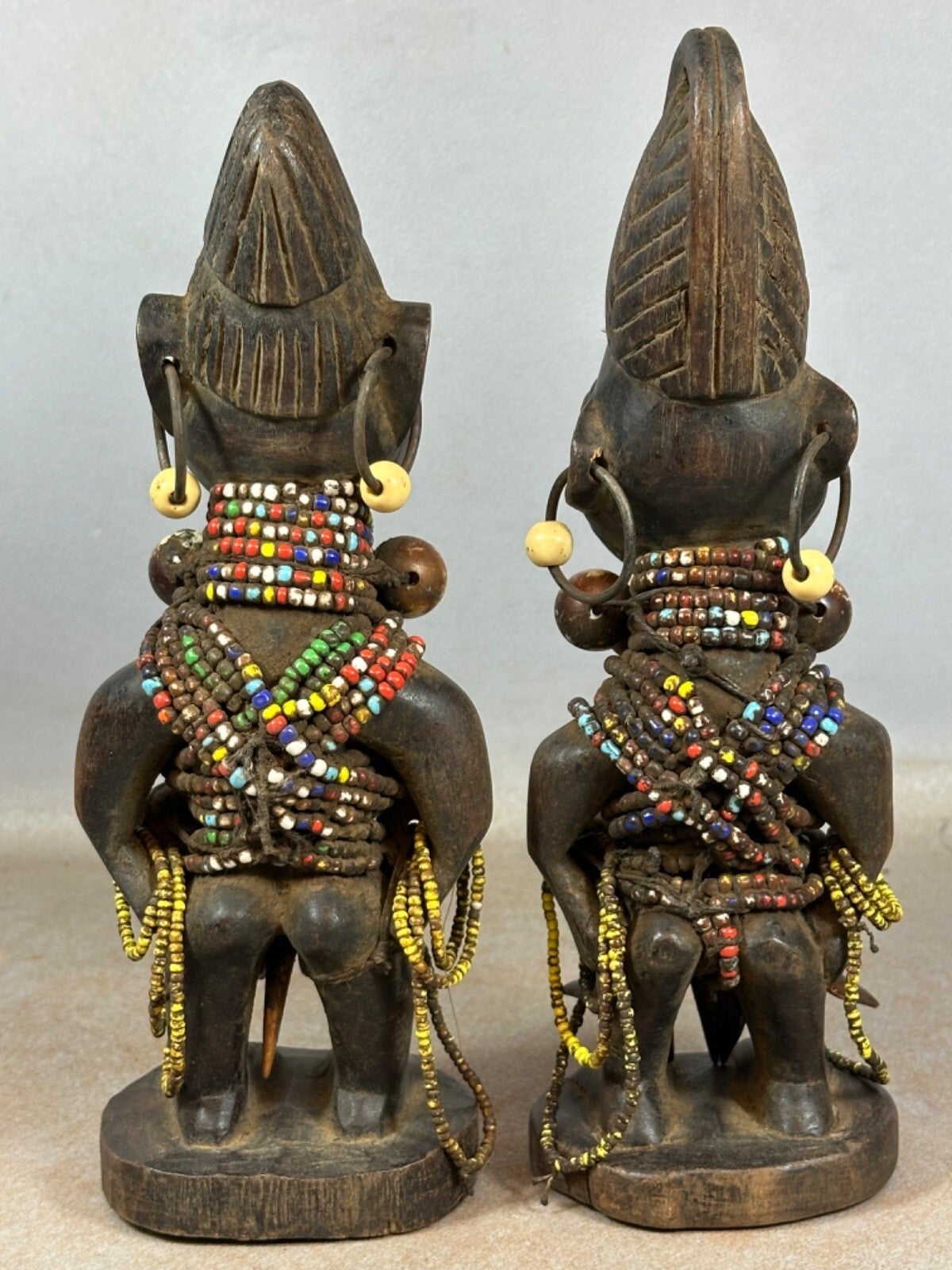
Couple African Ibeji Yoruba statues - Nigeria.
Hand carved from a single piece wood with many beads, shells, ed.
Size: 27 cm and 26 cm high.
The Yoruba ethnic group, which currently numbers over twenty million people, is the largest community in Africa.
The area inhabited by this ethnic group covers southwestern Nigeria and parts of southeastern Benin.
The origins of the Yoruba, which are largely based on legends and assumptions, suggest they originated in Egypt and Arabia.
A migration that, according to specialists, dates back to the twelfth century or even earlier is believed to be the cause of their presence in this region.
The Cult of the Ibeji
In the language of the Yoruba people, IBEJI means twins: IBI = born and EJI = two. In Yoruba religious tradition, twins are believed to have one soul, connected and inseparable.
The Yoruba people, numbering over 12 million, are the largest nation in Africa with an art-producing tradition. Most of them live in southwest Nigeria, with considerable communities further west in the Republic of Benin and in Togo. They are divided into approximately twenty separate subgroups, which were traditionally autonomous kingdoms. Excavation at Ife of life-sized bronze and terracotta heads and full-length figures of royalty and their attendants have startled the world, surpassing in their portrait-like naturalism everything previously known from Africa. The cultural and artistic roots of the Ife masters of the Classical Period (ca. 1050—1500) lie in the more ancient cultural center of Nok to the northeast, though the precise nature of this link remains obscure.
Now two-third of the Yoruba are farmers. Even if they live in the city, they keep a hut close to the fields; they grow corn, beans, cassava, yams, peanuts, coffee, and bananas. It is they who control the markets -- along with the merchants and artisans: blacksmiths, copper workers, embroiderers, and wood sculptors, trades handed down from generation to generation.